Will Applied AI Transform the 2026 Roadmap? thumbnail

Will Applied AI Transform the 2026 Roadmap?

Published en
6 min read


For its part, the U.S. Department of Justice explains that the CLOUD Act has allowed bilateral executive agreements to assist in access to information in cases including "severe criminal activities," within safeguards to protect rights. By contrast, service providers such as AWS Use a protective interpretation regarding privacy, with Amazon stating there is "no automated access to information," and stating that it has not disclosed the content of government/institutional consumers kept outside the United States to the U.S.

What Role Does Blockchain Play in Riyadh’s 2026 Fintech Scene?

Around 35% of cloud service centers in the region belong to American companies, totaling 31 centers, while Chinese-owned centers account for about 8%, with 7. Iran, on the other hand, relies completely on four domestic business, giving it 100% regional cloud infrastructure. Overall, 42% of the region's cloud services are provided by regional or different international companies.

Overall, every Gulf nation has a U.S. cloud existence. Israel relies 100% on American service providers, including Microsoft, Google, Amazon, and Oracle. Iran: The cloud ecosystem is effectively localized. The research clearly found that the Iranian state has, for many years, built an infrastructure that keeps critical services running domestically even if international connection is cut off through the National Details Network (NIN).

ANSR July GCC PRs 50DR+ANSR July GCC PRs 50DR+


The Role of AI in 2026 Market Growth

sanctions. More than half of the cloud releases in the area (51%) were introduced after 2020, with 46 centers out of a total of 89 established throughout that duration. 89 centers each nationality's share of overall presences Variety of presences/centers in the region Overall cloud presences per country Stated service type/sector Show the detailed table for all centers (89 centers) #CountryLocationCenter nameOperatorNationalityOwnerYearClassificationCoverageAZ The investigation focused on studying all cloud service centers in the Middle East and North Africa area, across their three classifications in regards to size and capacity to supply services: All hyperscaler centers are operated by international companies such as AWS, Azure, Google, and Oracle, the majority of which are situated in the Gulf states and "Israel." Other countries store their data in city government information centers or local telecom-company data centers, which fall within the second and 3rd tiers of the classifications.

In cases of dispute or sanctionsas in Syria and Yemenbarriers boost due to the fact that of compliance constraints and damage to infrastructure. Cloud computing services are a model that enables "on-demand" access to shared computing resources (networks, servers, storage, applications, and services) that can be rapidly provisioned and launched with minimal administrative effort.

several different sites/data centers within the area, created to decrease single points of failure, with separation in power, cooling, physical security, and low-latency network connectivity. There are likewise layers of cloud services or service shipment designs (IaaS/PaaS/SaaS) and deployment and usage designs (public/private/hybrid/ community), which are an essential part of understanding and examining risks and sovereignty over cloud service centers in the countries that host them.

ANSR July GCC PRs 50DR+ANSR July GCC PRs 50DR+


Information analytics and expert system: cloud centers provide huge computing and storage capability to run information analytics for states and governments, device knowing, and AI workloads that need specialized and massive hardware. This, for instance, is one factor behind the race by information centers and AI to establish an existence in the Gulf and offer services there.

Driving Digital Innovation in Middle East Sectors

This is the logic behind creating schedule zones within a region, or across several regions when laws permit. The kind of cloud service use depends upon each nation's policy and its data classification, but the most common patterns in the public sector consist of: individual information, files, residency records. taxes, custom-mades, and federal government procurement.

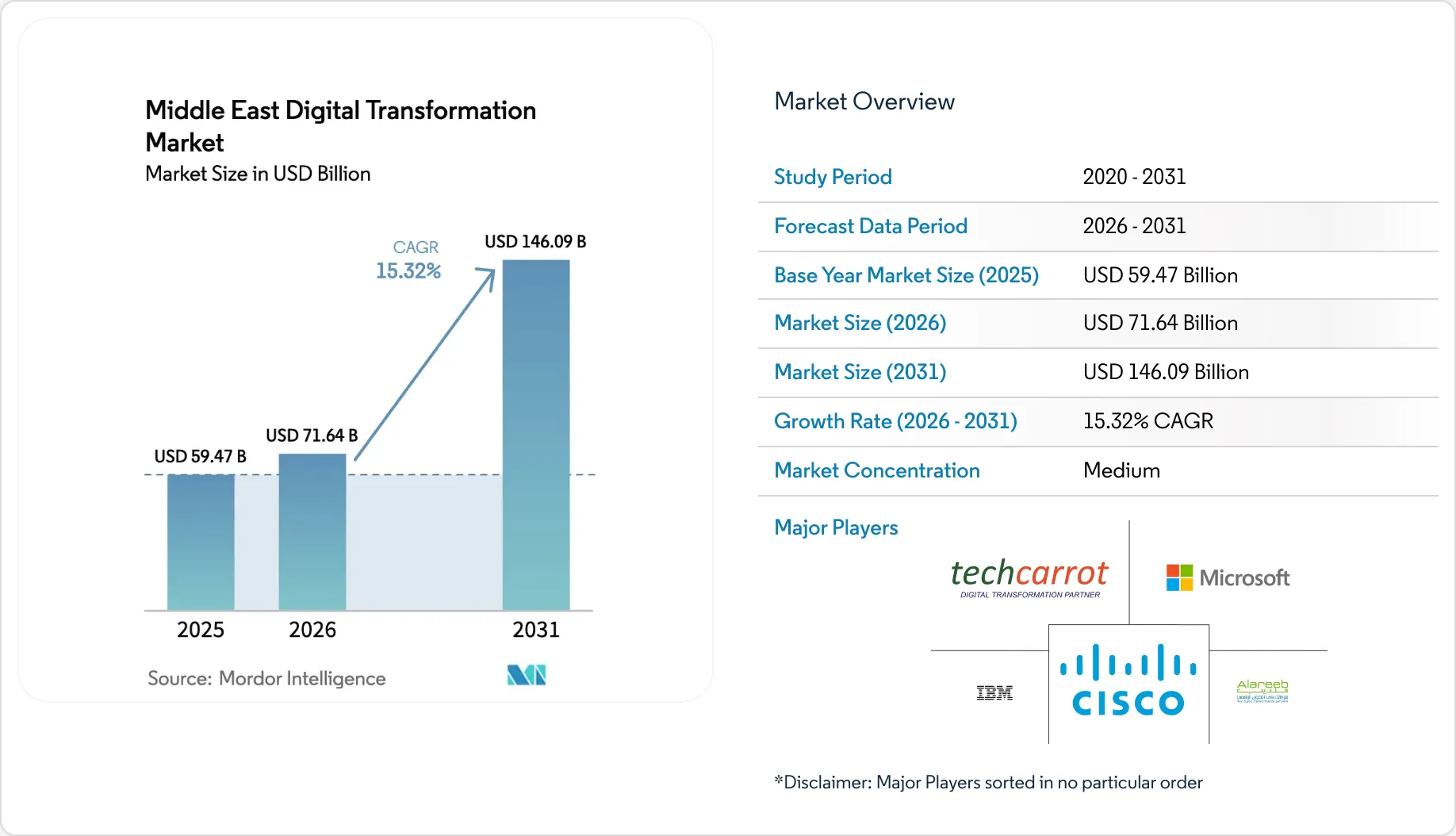
the Internet of Things, noticing, traffic, energy/water. often greatly restricted and isolated, or special/sovereign environments are constructed for it depending upon classification sensitivity. This is where the importance of deployment models (private/hybrid cloud)becomes clear: many federal governments tend toward a hybrid approachpartly on a public cloud for less delicate work, and partly on a private/sovereign cloud for more sensitive ones. The RUSI research institute states that the targeting of data centers in the Gulf on March 1, 2026 developed global doubts about the resilience, sovereignty, security, and fragility of these centers, noting that data centers might be treated as tactical possessions and "critical facilities,"especially if they are thought to support defense/intelligence capabilities alongside civilian services. The danger is not just"losing files,"however digitally disabling and disabling states. It can be summed up in 5 points: Critical service blackouts (Availability Shock): If banks, payments, public service platforms, or significant business depend on the affected region, the interruption quickly impacts the general public and the economy. RUSI pointed to broader disruption to financial and consumer services after the Gulf strikes. Fragility in the face of non-cloud traffic jams: Even if information centers are not bombed, submarine cables and globalconnectivity can trigger extreme congestion/degradation in cloud services. Example: cuts to cable televisions in the Red Sea impacted Azure paths and increased latency in South Asia and the Gulf. The cloud services market represents a big global market, and costs on it is progressively increasing year after year with the development and expansion of expert system services. Regionally, Gartner, the research, consulting, and info innovation firm, anticipates IT costs in the Middle East and North Africa to reach 169 billion dollars in 2026, and states that" information center systems"are the fastest-growing industry, estimated at 12.984 billion dollars in 2026. McKinsey, meanwhile, describes public cloud centers in the Middle East as a"multibillion-dollar opportunity" linked to digital transformation and onethat is highly scalable. This is either due to the fact that they are variable consumption-based contracts, framework arrangements, or part of wider procurement portfolios (digital transformation)that are not openly detailed. Nevertheless, the following can be recognized: According to a report released by Arab News in 2015, the value of government agreements in the ICT(Info and Communications Innovation)sector reached SAR 38 billion in 2024(around US$ 10.13 billion), with a concentrate on cloud computing and expert system as top priorities. In 2024, Amazon revealed the construction of 2 cloud regions in Saudi Arabia at an expense surpassing US$ 5.3 billion. In the same year, Oracle also announced the launch of a second public cloud region in Saudi Arabia to "strengthen the AI economy,"with a financial investment of US$ 1.5 billion. In March 2025, the Abu Dhabi government revealed its goal of automating 100 %of government operations, supported by a financial investment of approximately AED 13 billion(US$ 3.54 billion)in digital facilities under the Digital Strategy 20252027, together with sovereign cloud agreements with Microsoft and Core42. In November 2025, the state-owned business qnbn announced the signing of a multi-year agreement with Microsoft to offer cloud computing services aimed at"accelerating digital change and artificial intelligence,"though the agreement's worth was not disclosed.

Latest Posts

GCC Tech Innovation Trends

Published Aug 07, 26
2 min read

Key Strategies for Managing Applied AI Systems

Published Aug 07, 26
1 min read

Next-Gen Development Trends for 2026

Published Aug 07, 26
5 min read